
Best Uses for a Handheld Belt Sander – Everything You Need to Know
Whenever a professional thinks about fine woodworking, a handheld belt sander probably won’t be the first tool that comes to mind. This is because, quite often, when working on a project that involves building a piece of furniture which requires exact precision, other tools come into play.
A handheld belt sander, on the other hand, is designed to help you carry out much bulkier projects such as taking some stock from the faces of pieces of wood quickly enough so you can get to the fine woodworking bits faster.
This is to say that, despite not being a major player in the art of fine woodworking, a belt sander is something you want to have in your workshop for several very good reasons. Reasons that we are going to explore today.
What Is a Handheld Belt Sander?
Have you ever wasted precious hours manually sanding through the wood because the joints just didn’t quite fit right or you hadn’t achieved the kind of finish you wanted before you stain it?

Those are the kind of hours that a belt sander can save you. Instead of manually sanding through the wood, simply use a handheld belt sander to get the job done faster and to a higher degree of workmanship.
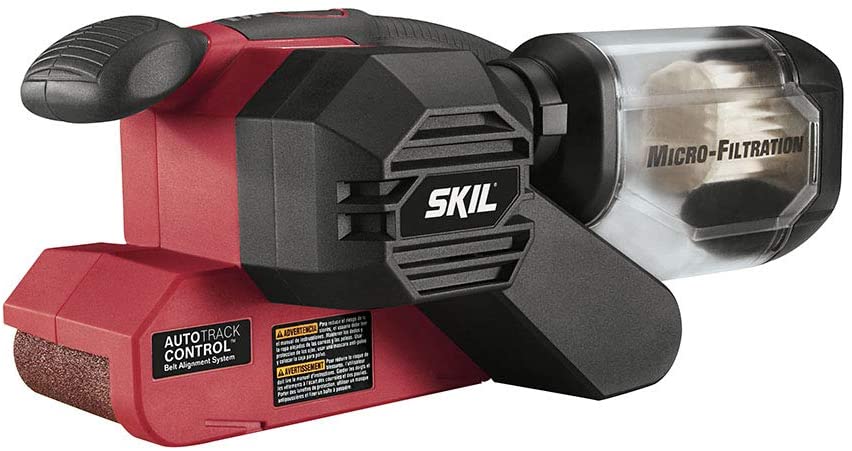
A belt sander is a heavy-duty woodworking tool that has sanding belts wrapped around its base. This belt is made up of sandpaper and is wrapped around two drums that seamlessly rotate. To use this tool, you first have to choose the appropriate grit of sandpaper to ensure that you have the right results.
You can then secure the piece of wood to be worked and simply run the belt sander over it until you get the desired finish. This is the kind of tool you use to clean up the surface of any wood project you want to undertake.
One of the biggest advantages is that you can change out the sandpaper belt to tackle the different types of surfaces to be cleaned up. If you want to take on things like polyurethane coatings or dark stains, go for heavier grit sandpaper (between 60 and 80).
However, if you want to take on finer projects such as sanding bookshelves and cabinets, you should consider medium or finer grits between 100 and 220. With the right sandpaper, you can even use a belt sander to strip the surface of metal projects.
What Are Handheld Belt Sanders Used for?
As you have probably already picked up, handheld belt sanders can be used for a wide variety of surface stripping and sanding jobs. However, as we mentioned at the beginning of this piece, some finer jobs aren’t ideal for this heavy-duty tool.
Here are some projects on which a belt sander would come in great handy:
1. Fix Sticking Doors
Homeowners across the globe experience the same problem: interior doors that won’t close properly because they rub against the floor or the frame. This not only makes these doors difficult to open and close but also produces an irritating grating sound every time there is an attempt to do so.

You will most likely experience this issue during the warmer months when the wood expands thanks to the heat and high humidity. A belt sander is the perfect power tool to quickly fix this problem.
All you have to do is remove the door slab from its frame and put in on some sawhorses. Use your belt sander on the edge that is sticking by easily removing a few inches by sanding it down.
For the most part, you won’t even have to remove that much. Often, removing 1/16 to 1/8 inch is enough to fix the problem.
2. Re-Finish Wood or Even Metal
Technically speaking, a sanding belt is primarily used for a sanding job on large or flat surfaces such that can be found on wood furniture or other places such as on doors. That, however, doesn’t mean that this kind of sander is exclusive to wood. By swapping out the sandpaper on the rollers, you can fashion it in such a manner as to help you re-finish metal surfaces as well.
In fact, this is one of the biggest advantages that this power tool brings to the table: you can swap out the sandpaper to customize it to the kind of surface finish you want to achieve. For example, if you wanted to work on a metal surface, you would simply swap out the sandpaper and replace it with one that is designed for metal surfaces. These differ greatly from the ones designed for wood surfaces, so you need to be quite careful when swapping them out.
Additionally, you can use a sander to achieve a finer finish on surfaces by using sandpaper that has a medium or finer grit. This means that you can use a powerful belt sander to work on your kitchen tables, bookshelves, cabinet shelves and even wooden floors.
3. Re-Finish Outdoor Furniture
Anyone who owns outdoor wood furniture knows what kind of havoc the elements can wreak on what is essentially a beautiful deck, garden table and chair. This, however, doesn’t mean that you have to buy new ones of surfer the faded looks.
You can simply use a belt sander to give them all a brand new look. By picking the right sandpaper grit, you can sand the surfaces of your outdoor wood furniture down to the wood’s natural finish. You can also switch to lighter grits to give them a smoother finish without damaging the outdoor furniture. From then on, you can finish them off with your desired Steiner or vanish.
Because handheld belt sanders have higher RPM and amperage rates, they are the perfect tools to use when you need to quickly and conveniently sand large, flat surface areas. Whether you are dealing with wood or metal, the sandpaper you use will allow you to achieve the kind of finish you want.
For that reason, belt sanders are some of the most convenient heavy-duty tools that you can buy today. It helps that they are also quite easy to use.