This post contains affiliate links. If you buy through a link on this page we may earn a commission from qualifying purchases at no extra cost to you.
An oscillating tool can cut ceramic tile and remove grout cleanly, using a carbide-grit or diamond-grit blade rather than a toothed one. It excels at notches, curved cuts, and grout removal, but struggles with dense porcelain and long straight cuts, where a wet saw or angle grinder is faster.
Cutting tiles can take a long time when you are using a manual tile cutting tool. The manual process takes longer as you also need to trim and shape the tiles after you have cut them. But if you want to save time and energy, you need a tool that can do all of these things. This is where the oscillating tool comes in.
Cutting tiles requires you to use a tile nipper, tile file, tile cutter, and sometimes a driller, too. Buying all of these pieces of machinery can start costing a lot of money, especially when you compare this cost to an oscillating tool. So, how effective is an oscillating tool at cutting tile? Let’s take a look.
Cutting tile with an Oscillating Tool
Unless you are a professional tiler, chances are that you don’t have the correct tools in your garage to cut tiles. If you would like to cut the tiles to renovate your bathroom or kitchen, you will benefit greatly from using an oscillating tool. We can also use oscillating tool to cut metals.
How an Oscillating Tool Works
An oscillating tool works in a side to side motion. The oscillation angle is between 2 and 4 degrees and moves very rapidly – at roughly 20,000 strokes a minute. The machine feels like it is vibrating due to this fast movement.An oscillating tool vibrates its blade in an arc and therefore doesn’t kick up very much dust, unlike a rotary tool, jig saw, or reciprocating saw. By using the right accessories, an oscillating tool can become one of the most effective and useful tools in your garage. There are many cordless oscillating tools, but best corded oscillating tools are too available in the market.
Choosing the Ideal Blade
When you cut a tile with a tile cutter, you have to manually place the tile in the cutter and check that it is positioned correctly so that you cut it to the perfect shape and size. Even when you take meticulous care to do so, you are not always guaranteed an ideal outcome, which is where a tile nipper and file come in handy.
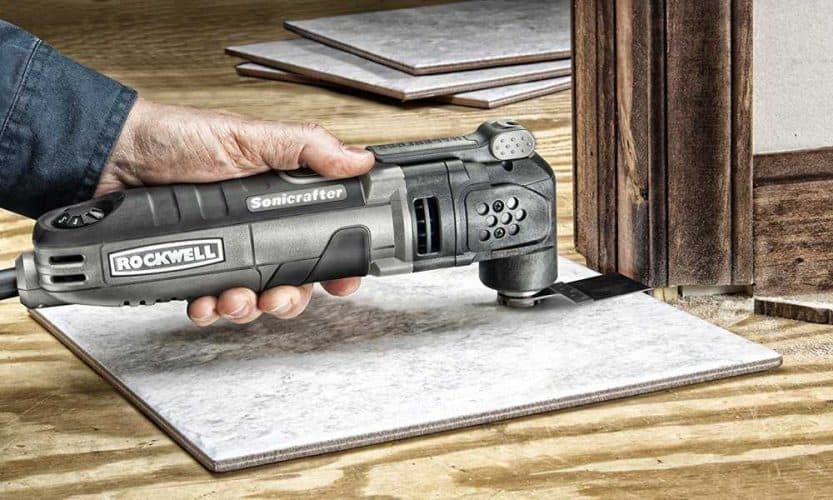
However, with an oscillating tool, you use blades the accurately show you where the tile will be cut, which means you can cut your tiles accurately every time. And, even if you don’t get it right the first time, the oscillating tool can then be used as a tile nipper to handle the job.
Use a Tile Scrap
Oscillating tools move according to the blade you install. There is a wide selection of blades to choose from, and you can cut many different items using an oscillating tool, including pipes and cutting metals. By using just one tool to cut tiles, you are making your job much simpler.And to guarantee perfectly sized tiles when using an oscillating tool, you should use a tile scrap as your basis. Place the tile you want to cut under the tile scrap, and the oscillating tool will trace around the tile scrap which will result in a perfect duplicate.
Use the Oscillating Tool as a Tile File
Similarly to filing your finger nails, tiles need to be filed in order to emphasize their shape. Tile files also work to make sure that no small fragments are left on the edges of your tile so you can properly place it when applied. If you don’t have a tile file, you can also use your oscillating tool as one.An oscillating tool is a multipurpose tool, which means that you can use it to complete the entire tile cutting process. And as you improve your skills with your oscillating tool, there are many ways to use it.
Why Use an Oscillating Tool to Cut Tile
Cutting tiles by hand doesn’t only take a lot of time, but it also requires more energy and money than using an oscillating tool. Buying two or more items of equipment to cut tiles is impractical when you can use one tool instead.Manual tools are normally considered a lot safer than power tools, but machinery like an oscillating tool provide you with a great deal more convenience as well as a cost-effective and time-saving solution.
FINAL VERDICT
An oscillating tool can make your tile-cutting experience so much simpler. Oscillating tools are reliable and easy-to-use, and they give you a very smooth result.
This multipurpose tool has been proven as an effective tile cutting tool time and time again. This tool is very versatile and can be used to sand, cut, polish, grind, and scrape, thanks to its interchangeable accessories. Cordless oscillating tool best you can have are also available in the market.
The Right Blade for Tile Work
Toothed wood and metal blades do not cut tile — they chip the glaze and burn out in seconds. Tile work needs abrasive-edge blades:
Carbide-grit segment blades handle grout removal and cuts in soft ceramic and wall tile. A proven pick is the DEWALT DWA4220 carbide grout blade, which fits most non-Starlock tools.
Diamond-grit blades cost more but last several times longer and are the only realistic option for porcelain and natural stone, which are far harder than glazed ceramic.
Expect abrasive cutting to be slow: roughly 1–2 inches per minute in ceramic, slower in porcelain. That patience is the trade for cuts a wet saw physically cannot make — L-notches around outlets, curves around pipes, and repairs in the middle of an installed floor.
Technique That Prevents Cracked Tile
Mark the cut and score it lightly first at low speed; deepen gradually rather than plunging.
Run mid-range speed — high speed glazes the grit and overheats the tile edge.
Never force it: pressure cracks tile long before it speeds up an abrasive cut.
Dust control matters — tile dust contains silica. Cut with a vacuum nearby and wear a respirator; oscillating tools cut dry, so there is no water spray managing dust for you.
Where the Oscillating Tool Wins on Tile
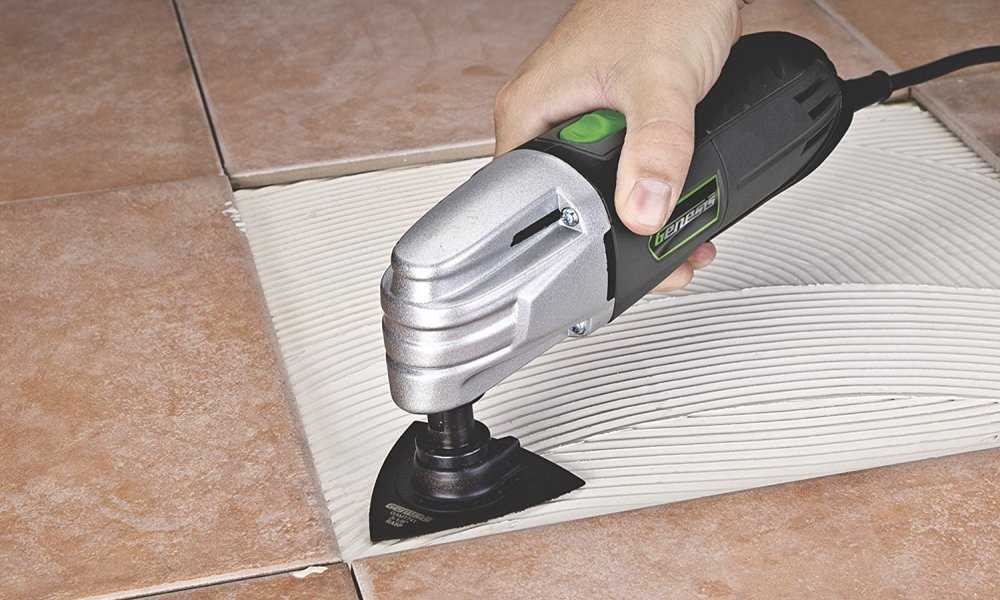
Grout removal is its killer app. A carbide-grit blade tracks a grout line cleanly without biting neighboring tiles — faster and far safer than a manual grout saw, and more controllable than an angle grinder. For regrouting a shower or replacing one cracked tile in the field, it is the best tool available to a DIYer.
Picture the common repair: one cracked tile in the middle of a kitchen floor. A wet saw is useless there. With an oscillating tool you grind out the grout on all four sides, break out the damaged tile without disturbing its neighbors, clean the thinset off the substrate with a rasp attachment, and set the new tile — one tool, no collateral damage. That single job justifies the blade purchase for most homeowners.
Know when to put it down, too. Cutting a whole floor’s worth of tile to size is wet-saw work, and a single long straight trim goes faster with a grinder and diamond wheel. The oscillating tool earns its place on the fiddly ten percent of cuts the big tools can’t make.
Questions That Come Up
Can an oscillating tool cut porcelain tile?
Only with a diamond-grit blade, slowly, and best limited to small notches and adjustments. Porcelain’s density wears carbide grit quickly.
Will it cut tile that is already installed?
Yes — that is its main advantage. Plunge cuts in the middle of an installed wall or floor are exactly what the tool geometry allows and what saws cannot do.
For small areas, yes, with a carbide rasp or segment blade. For a whole floor, a chipping hammer or floor scraper saves hours. Basics of tool handling are in our how-to guide.
[…] are a wide variety of functions that a rotary tool can do including grinding, sanding and cutting tiles and other materials. At the tip of the tool, there will be a place for an attachment or accessory, […]