
Random Orbital Sander vs Sheet Sander – What’s the Difference?
This post contains affiliate links. If you buy through a link on this page we may earn a commission from qualifying purchases at no extra cost to you.
It’s difficult to say that a technically challenging job like woodworking can have some exceptionally relaxing tasks. That, however, is exactly what I am saying. Certain tasks are not only mindless to a point but also almost instantly rewarding.
Sanding is one of those tasks. If you use the right sander for the job, you hardly have to worry about a thing as the machine purrs away and gives you instant results. That is why answering the question: which is better between orbital sander vs sheet sander is so important. Choosing the wrong one could make what should be a relaxing task a bit more frustrating.
Orbital Sander Vs Sheet Sander
So, which is which between an orbital sander and a sheet sander? Let’s take a quick look at them separately, so you have a very clear picture of which one is best suited for which type of sanding jobs.
Orbital Sander
Also known as a random orbital sander, this tool is quite similar to the sheet sander except for a few key differences. The main difference between these machines is hinted at in the name “random orbital sander” and has something to do with how the sanding pad moves.

In a random orbital sander, the sanding pad moves in a randomized circular motion which is achieved by an additional drive which ensures that the sanding pad makes a more elliptical movement than anything else. Because of this movement, this type of sander leaves minimal swirl marks on the surface.
However, since some additional requirements go into making this machine than those that go into a sheet sander, an orbital sander often tends to be a bit more expensive and more powerful than a sheet sander. That extra power makes this type of sander more ideal for use on rougher types of materials as well as through a couple of layers which is something that a sheet sander can’t do.
Another key feature is that there are holes in the circular disk on the sanding pad. These are used as the dust collection mechanism with this dust ultimately being collected in a dust bag at the end of the arrangement.
- P.S: Connecting the tool to a vacuum hose helps you to get rid of all the dust and keeps your workplace clean.
One more thing about random orbital sanders is that they vibrate quite a bit which means that using one for any prolonged duration can lead to some level of hand fatigue and even numbness.
Thankfully, though, a lot of the top tier models have an anti-vibration mechanism which minimizes the level of vibration that actually reaches you. Besides, you can always use anti-vibration gloves when using one of these machines.
Orbital Sander Pros
- It has a stronger motor: This is because it has to randomize the motion on its sanding pad; this extra power makes it ideal for tougher jobs.
- Versatility: Thanks to the extra power and randomized circular motion, you can use this machine on a wider variety of jobs than you could when dealing with a sheet sander.
- It has its own dust collection mechanism: If you do a lot of sanding and have a thing for keeping your workspace neat, this feature will be important to you.
- Doesn’t leave swirl marks: This is thanks to the randomize movement of the sanding pad.
- Offers smooth finishing: Since the orbital sander doesn’t leave marks, it’s ideal for finishing jobs.
- It offers variable speed control: Top tier models offer you variable speed control which allows you to alternate between settings depending on what you are currently working on.
Orbital Sander Cons
- Since it has round sanding discs that run on circular movement, the tool can’t quite reach corners or any 90-degree angles.
- It’s a bit more expensive.
- Doesn’t smooth very well between layers.
- It’s a bit more aggressive and should only be used on specific types of materials.
Sheet Sander
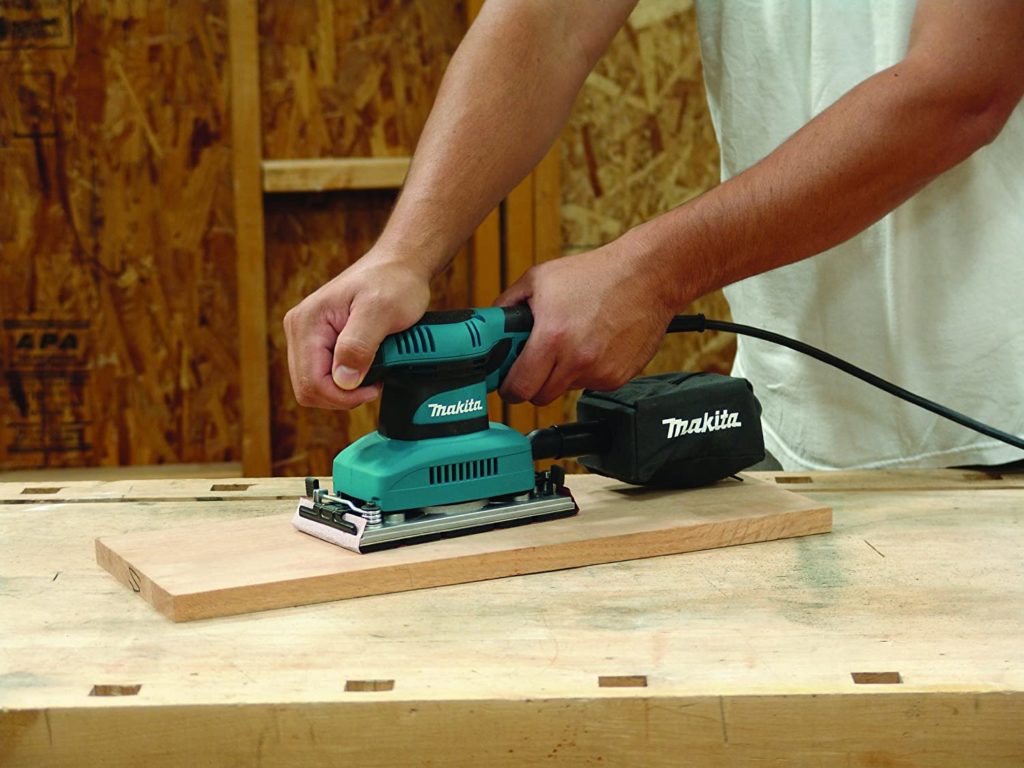
Also known as a “Finishing Sander” sheet sanders are designed for more delicate work and as the name suggests, for putting the finishing touches on your material. This tool is also called a “quarter sheet pad sander” in some circles because of the sandpaper used as part of this tool’s makeup; it’s a quarter of the 9X11 sheet.

Sheet sanders tend to have a rectangular sanding pad and work in a back and forth circular movement at extremely high speeds. This makes it perfect for detailed finishing jobs on small surfaces. Additionally, because it has a rectangular-shaped sanding pad, this sander is ideal for use on material that has sharp corners and 90-degree edges.
One thing you should note is that this sander isn’t designed to cut through a lot of layers in quick succession. The back and forth movement employed here means that it can only remove small amounts of material from the workspaces at any given time.
The one thing that makes owning a sheet sander ideal isn’t the fact that it’s the perfect machine for detailed finishing but also the fact that it’s not as expensive as most other types of sanders. Additionally, it’s running costs are very low since it uses regular sandpaper.
Sheet Sander Pros
- Affordable: This type of sander is relatively affordable and readily available in the market.
- Perfect for use on edges and corners: Because it has a rectangular sanding pad, it’s quite ideal for finishing those corners and curves.
- Lightweight: This tool isn’t heavy and doesn’t produce a lot of vibrations which means it will not tire you out as fast as most other sanders in the market. This makes it perfect for carpenters or woodworking enthusiasts who intend to do a lot of fine sanding.
- Portable: Because this tool is so lightweight, it’s quite easy to just grab and bring with you wherever you go.
- Excellent for fine finishing touches: If you are looking for a sander that offers you fine finishing touches and works well when smoothing between paint layers and coatings, this is it.
Sheet Sander Cons
- It offers low power output which means that it isn’t ideal for heavy-duty tasks which kind of limits it’s usability.
- It’s not as versatile as an orbital sander.
- It tends to leaves marks on the surface of your work material which you then have to get rid of using an orbital sander.
As you can see, the battle of orbital sander vs sheet sander isn’t exactly easy to call. It all comes down to what kind of work you want to do. Heavy-duty sanding calls for an orbital sander while fine finishes call for a sheet sander.