Chop Saw vs Miter Saw – Which One Should You Use?
A chop saw cuts metal with an abrasive wheel. A miter saw cuts wood with a toothed blade and pivots to cut angles. The names get swapped constantly because some people call any non-sliding miter saw a chop saw, but the two machines are not interchangeable and the blades are not either.
That terminology muddle is the actual reason this comparison is confusing. Walk into a hardware store and ask for a chop saw and you may be shown either machine, depending on who is working the floor.
What a Chop Saw Actually Is
A true chop saw — the trade name is an abrasive cut-off saw — spins a 14-inch abrasive disc at roughly 3,800 rpm straight down into ferrous metal. There are no teeth. The wheel works by grinding, it consumes itself as it cuts, and it throws a rooster tail of hot sparks that will find anything flammable within about ten feet. The head drops on a single vertical axis. It does not bevel and it does not swing left or right, because cutting angled steel is not what it is for.
Cutting wood with one is genuinely dangerous: the abrasive wheel scorches rather than cuts, and the dust it generates is a fire risk against a wheel running that hot.
What a Miter Saw Actually Is
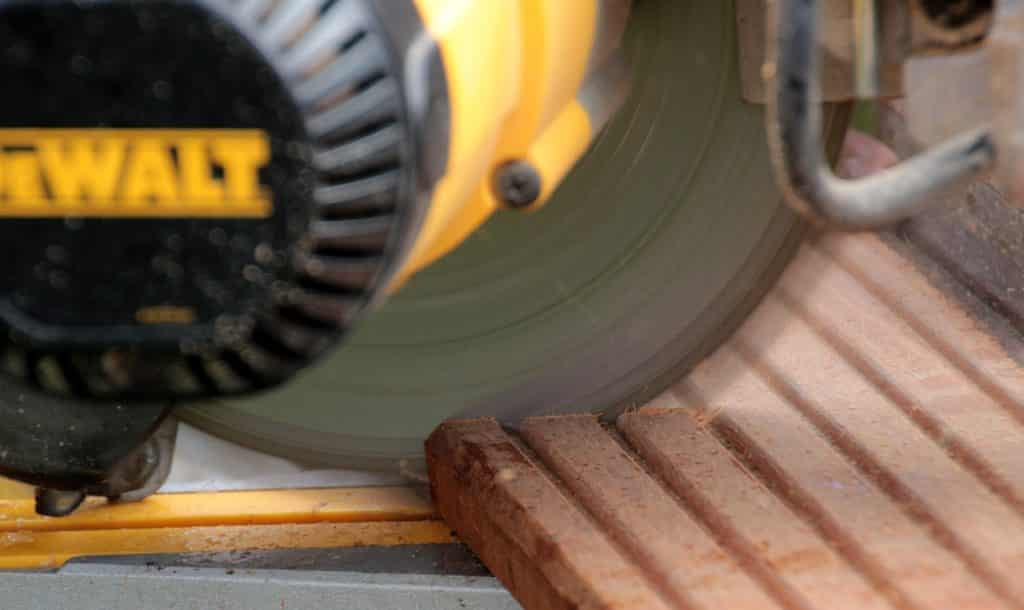
A miter saw spins a carbide-tipped blade, usually 10 or 12 inches, and the whole head rotates on a table so you can cut a mitre. Compound models tilt as well, for crown moulding and anything needing a bevel and a mitre at once. Sliding models add rails so the blade can travel through wider stock.
The Confusion, Resolved
When someone says “chop saw” and means wood, they almost always mean a basic non-sliding miter saw — one that only chops straight down. That usage is common enough on job sites that fighting it is pointless. Just ask one question before buying anything: metal or wood? The answer picks the machine, and nothing else about the decision matters nearly as much.
Which One You Need
Cutting conduit, rebar, angle iron, threaded rod or steel studs: you want the abrasive chop saw. Cutting trim, framing lumber, decking, flooring or anything at an angle: you want the miter saw. Doing both regularly means owning both, because swapping blade types across these machines is not an option — the arbor sizes, the speeds and the guards are all built around different assumptions.
Our Recommended Chop Saw
The PORTER-CABLE PCE700 is a 15-amp, 14-inch abrasive saw with a quick-release vice, which matters more than it sounds: most of the time lost on a cut-off saw is spent clamping stock, not cutting it.
CHECK LATEST PRICE ON AMAZON.COM
Our Recommended Miter Saw
The SKIL MS6305-00 is a 10-inch dual-bevel slider, and the rails are what make it worth the extra over a fixed head — a 10-inch slider will cross-cut wider boards than a 12-inch saw that cannot travel. Dual bevel means it tilts both ways, so you are not flipping long trim end for end to cut the opposite miter.
CHECK LATEST PRICE ON AMAZON.COM
One Upgrade Worth Knowing About
If you are cutting a lot of metal and the sparks and the smell are wearing thin, the thing you actually want is a cold saw — a toothed, slow-turning metal saw that cuts cleanly, leaves an edge you can touch, and does not consume a wheel every few dozen cuts. They cost several times what an abrasive saw costs, which is why most shops put up with the sparks. But if you reach for the chop saw every day, price one out. For angles in wood, our guide to sliding compound miter saws covers the bevel and slide decisions in more detail.